
ANALYTICAL TESTING
A range of methods are suitable for determining thermal properties such as melting temperature, glass transition temperature, filler content, and flammability of a plastic or finished product. Within thermal materials testing, numerous procedures exist to determine these characteristics.
As a plastics laboratory accredited according to DIN EN ISO/IEC 17025, we verify regulatory and quality standards and determine the actual thermal parameters of a product. We provide a broad portfolio of thermal testing services, applicable both to samples taken from finished products or components as well as raw materials. Simply send us the sample material.
Our plastics laboratory performs the following thermal tests:
- DSC – Differential Scanning Calorimetry (DSC analysis of plastics) – Determination of melting behavior, glass transition temperature, and glass temperature of plasticsn
- TGA – Thermogravimetric Analysis (TGA analysis of plastics)
- Flammability testing of flame-retardant plastics according to FMVSS 302, DIN 75200, ISO 3795, VW TL 1010, DBL 5307, BMW GS 97038, Jaguar LRLTM.30.MS.302 (determination of flammability characteristics of plastics, burn rate, combustion rate, flammability testing, flame retardancy)
- Determination of filler and glass fiber content
- Determination of ash content
- Thermal conductivity and heat deflection of plastics
- Heat storage / climate conditioning
- Determination of Vicat softening temperature (VST / Vicat Softening Temperature)
RHEOLOGICAL TESTING
Rheological properties of plastics can be determined using various testing methods. To verify your products with regard to quality standards and key rheological characteristics, simply send them to us for analysis.
Rheology is defined as the scientific discipline dealing with the flow and deformation behavior of materials up to their melting temperature. The rheological properties of a plastic material can be determined through multiple rheological test procedures.
In our testing laboratory, accredited according to DIN EN ISO/IEC 17025, we conduct the following tests to determine the rheological characteristics of your plastic material:
- Determination of the Melt Flow Index (MFI) of plastics: Melt Mass-Flow Rate (MFR) and Melt Volume-Flow Rate (MVR)
- Determination of the viscosity number of plastics (solution viscosity)
EMISSIONS TESTING
Emissions testing ensures that materials and components meet environmental and health compliance requirements. Using advanced analytics, we evaluate emissions and residual substances to ensure safety, purity, and regulatory conformity.
- Fogging
- Odor behavior
- Determination of residual contamination
- Determination of PAH content (polycyclic aromatic hydrocarbons)
- Determination of brominated flame retardants
- Determination of plasticizer content
- Determination of PAH content
OTHER TESTING SERVICES
Our extended testing portfolio covers additional material performance assessments to ensure that your plastics meet operational, structural, and long-term stability requirements. These methods provide reliable data for qualification, approval, and comparative validation of materials and parts.
Our additional testing capabilities include:
- Density
- FTIR spectroscopy (infrared analysis)
- Determination of water absorption
- Determination of moisture / water content (Aquatrac methodology)
- Environmental stress cracking (ESC / stress-crack resistance)
- Oxidation stability (WAP test for PP)
- Chemical resistance testing
- Steam-jet testing
- Long-term endurance testing according to specification
We are your point of contact
You would like to request a test or obtain technical consultation? Feel free to contact us.




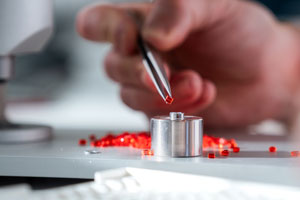
Thermal testing of plastics
Plastics must meet specific thermal properties to be regarded as high-quality. Product testing is performed in compliance with your specifications and requirements. Testing of your components takes place quickly and efficiently in our modern laboratory.
The following standardized and many additional thermal tests are part of our service portfolio:
- FMVSS 302: Flammability of Interior Materials
- DIN 53497: Warmlagerungsversuch an Formteilen aus thermoplastischen Formmassen ohne äußere mechanische Beanspruchung
- DIN 53508: Prüfung von Kautschuk und Elastomeren – künstliche Alterung
- DIN 53752: Bestimmung des thermischen Längenausdehnungskoeffizienten
- DIN 75200: Bestimmung des Brennverhaltens von Kunststoffen der Kraftfahrzeuginnenausstattung
- DIN 75220: Alterung von Kfz-Bauteilen in Sonnensimulationsanlagen
- DIN EN ISO 105-B06: Farbechtheit und Alterung gegen künstliches Licht bei hohen Temperaturen: Prüfung mit der Xenonbogenlampe (Heißlichtalterung)
- DIN EN ISO 306: Bestimmung der Vicat-Erweichungstemperatur (VST)
- DIN EN ISO 75: Wärmeformbeständigkeitstemperatur A, B oder C
- DIN EN ISO 1172: Bestimmung des Textilglas- und Mineralfüllstoffgehalts
- DIN EN ISO 3451: Bestimmung des Aschegehalts
- DIN EN ISO 3451-1: Bestimmung des Aschegehalts – Teil 1: Allgemeine Verfahren
- DIN EN ISO 3451-4: Bestimmung des Aschegehalts – Teil 4: Polyamide
- DIN EN ISO 11357: Dynamische Differenz-Thermoanalyse (DSC)
- DIN EN ISO 11357-1: Dynamische Differenz-Thermoanalyse (DSC) – Teil 1: Allgemeine Grundlagen
- DIN EN ISO 11357-2: Dynamische Differenz-Thermoanalyse (DSC) – Teil 2: Bestimmung der Glasübergangstemperatur und der Glasübergangsstufenhöhe
- DIN EN ISO 11357-3: Dynamische Differenz-Thermoanalyse (DSC) – Teil 3: Bestimmung der Schmelz- und Kristallisationstemperatur und der Schmelz- und Kristallisationsenthalpie
- DIN EN ISO 11357-4: Dynamische Differenz-Thermoanalyse (DSC) – Teil 4: Bestimmung der spezifischen Wärmekapazität
- DIN EN ISO 11357-5: Dynamische Differenz-Thermoanalyse (DSC) – Teil 5: Bestimmung von charakteristischen Reaktionstemperaturen und -zeiten, Reaktionsenthalpie und Umsatz
- DIN EN ISO 11357-6: Dynamische Differenz-Thermoanalyse (DSC) – Teil 6: Bestimmung der Oxidations-Induktionszeit und Oxidations-Induktionstemperatur
- DIN EN ISO 11358-1: Thermogravimetrie (TG) von Polymeren – Teil1: Allgemeine Grundsätze
- ISO 3795: Bestimmung des Brennverhaltens von Werkstoffen der Innenausstattung
- BMW GS 97038: Bestimmung des Brennverhaltens von Werkstoffen der Kraftfahrzeuginnenausstattung
- DBL 5307: Schwerentflammbarkeit Innenausstattungsteile
- Jaguar LRLTM.30.MS.302: Flammability of Interior Materials
- VW TL 1010: Innenausstattungsmaterialien – Brennverhalten, Werkstoffanforderung
- VW TL 1011: Entflammbarkeit nichtmetallischer Werkstoffe – Brennverhalten, Werkstoffanforderung
- VW PV 1200: Prüfung der Klimawechselfestigkeit
- VW PV 2005: Prüfung der Klimawechselfestigkeit
Rheological Plastics Testing
The Melt Flow Index is used to characterize melt behavior and—depending on the method—provides information on mass (MFR) or volume per time (MVR). A melt index testing device determines the rheological parameters MFR (Melt Mass-Flow Rate) and MVR (Melt Volume-Flow Rate) for plastics.
The viscosity number is determined using a capillary viscometer. These measured values serve as essential quality parameters for plastics processing. We evaluate the differences between raw material and final component. This allows us to quantify material degradation that may occur during your production process.
In our plastics laboratory accredited according to DIN EN ISO/IEC 17025, we provide the following rheological testing services:
- DIN EN ISO 1133-1: Determination of the melt mass-flow rate (MFR) and melt volume-flow rate (MVR) of thermoplastics
- DIN EN ISO 1628-1: Determination of the viscosity of polymers in dilute solution using capillary viscometers – Part 1: General principles
- DIN EN ISO 1628-2: Determination of the viscosity of polymers in dilute solution using capillary viscometers – Part 2: Poly(vinyl chloride) resins
- DIN EN ISO 1628-5: Determination of the viscosity of polymers in dilute solution using capillary viscometers – Part 5: Thermoplastic polyester (TP) homopolymers and copolymers
- ISO 1628-4: Determination of the viscosity of polymers in dilute solution using capillary viscometers – Part 4: Polycarbonate (PC) moulding and extrusion materials
- DIN EN ISO 307: Polyamides – Determination of viscosity number
Differential Scanning Calorimetry (DSC) and Thermogravimetric Analysis (TGA)
DSC testing (Differential Scanning Calorimetry) is the most widely used thermal analysis method due to its diagnostic power. It measures the heat flow difference between a reference sample and the actual sample using a dynamic differential calorimeter. This provides insight into melting behavior and glass transition temperature of plastics.
TGA (Thermogravimetric Analysis) determines mass change of a plastic as a function of temperature. Evaluation of the TGA test provides data such as filler content or ash content of a product.
Emissions Testing of Plastics
Plastics and plastic components are used across high-value industries such as automotive, construction, and medical technology. To ensure environmental compatibility and user safety, we analyze emissions under realistic exposure scenarios. These procedures give you confidence that your materials meet stringent emission limits.
We support the following standardized methods:
- DIN 75201: Determination of the fogging characteristics of trim materials in the interior of automobiles
- VDA 270: Determination of the odour characteristics of trim materials in motor vehicles
- VDA 275: Determination of formaldehyde release – modified bottle method
- VDA 277: Determination of organic emissions
- VDA 278: Thermal desorption of organic emissions for characterization of non-metallic automotive materials
- VW 50180: Parts, Components, Semi-Finished Products, and Materials in the Vehicle Interior – Emission Behaviour
- VW 96043 (PN 780): Vehicle Interior – Emission Behavior
- VW PV 3341: Determination of emission of organic compounds
- VW PV 3015: Gravimetric Determination of Condensable Components
- VW PV 3900: Odor Test
- VW PV 3925: Measurement by a Modified Bottle Method
- VW PV 3942: Testing Using the DUT Chamber Method
- BMW GS 97014-2: Determination of volatile organic emissions (CARB method, up to 70 substances)
- BMW GS 97014-3: Emissions measurement under air exchange in test chamber – determination of VOC emissions
- BMW GS 97014-4: Emission Measurement Under Air Exchange in a Test Chamber – Determination of Odor Behavior
General Plastic Testing
Plastics must meet defined performance criteria to be classified as high-quality materials. We test your components according to your requirements and applicable standards. Analysis is executed efficiently, documented clearly, and delivered with actionable results.
We support the following standardized test procedures (among others):
- DIN EN ISO 62: Bestimmung der Wasseraufnahme
- DIN EN ISO 1183-1: Verfahren zur Bestimmung der Dichte von nicht geschäumten Kunststoffen – Teil 1: Eintauchverfahren, Verfahren mit Flüssigkeitspyknometer und Titrationsverfahren
- DIN EN ISO 6270-1: Bestimmung der Beständigkeit gegen Feuchtigkeit – Teil 1: Kondensation (einseitige Beanspruchung)
- DIN EN ISO 6270-2: Bestimmung der Beständigkeit gegen Feuchtigkeit – Teil 2: Kondensation (Beanspruchung in einer Klimakammer mit geheiztem Wasserbehälter)
- DIN EN ISO 22088: Bestimmung der Beständigkeit gegen umgebungsbedingte Spannungsrissbildung (ESC)
- VW PV 3983: Media resistance of plastics and TPEs under mechanical load