
CLEANLINESS ANALYSIS
Technical cleanliness of components is a decisive quality factor in industries such as automotive, aerospace, medical technology, electronics, and semiconductors. Contaminants — including particles, machining residues, or environmental deposits — can significantly compromise functionality, safety, and product lifetime. To mitigate these risks, strict and highly sensitive cleanliness testing is essential.
As a DIN EN ISO/IEC 17025 accredited laboratory, we conduct technical cleanliness analysis according to relevant standards and OEM specifications. Using advanced analytic methods, we determine type, quantity, and size of contaminants and evaluate their functional impact. Testing can be performed on individual components or complete assemblies — simply provide your samples.
Our cleanliness analysis services include:
- VDA Band 19.1 (accredited)
- ISO 16232 (accredited)
- DBL 6515
- VW PV 3336
- VW PV 3347
- ZF 0000 700 815
- Bosch 1 582 990 125
We are your point of contact
You would like to request a test or obtain technical consultation? Feel free to contact us.


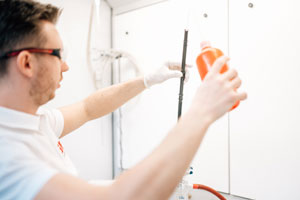

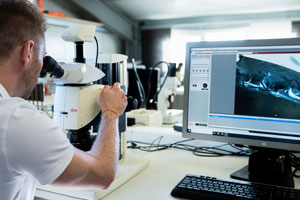
Cleanliness Testing
Components must meet strict cleanliness thresholds to guarantee proper function and quality. Testing is conducted based on your specifications and required regulations. In our laboratory, analysis is performed rapidly, accurately, and reproducibly.
We support the following standardized procedures:
- VDA Band 19.1: Technical cleanliness – particulate contamination of functionally relevant automotive parts
- ISO 16232: Cleanliness of components and systems
- DBL 6515: Determination of component cleanliness
- VW PV 3336: Cleanliness of Lines and Circuit Parts – Determining Residual Particle Quantities
- VW PV 3347: Cleanliness of Engine/Motor Parts – Determining Residual Particle Quantities
- ZF 0000 700 815: Residual contamination analysis on transmission parts
- BOSCH 1 582 990 125: Contamination inspection
Your component defines the cleanliness target — we deliver quantifiable contamination data. If additional procedures, threshold assessments, SEM particle classification, or OEM-specific evaluation protocols are required, we provide full technical support.